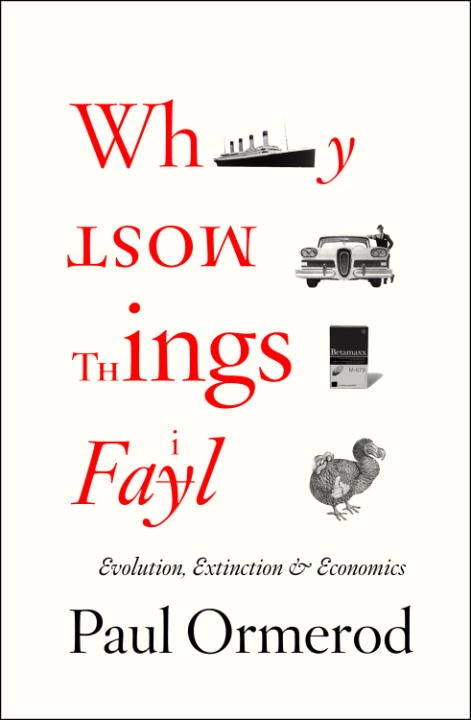
a book
Why Most Things Fail
Paul Ormerod · 2007 · 254 pages
Linking economic models with models of biological evolution, Why Most Things Fail identifies the subtle patterns that comprise the apparent disorder of failure and analyzes why failure arises. Throughout the book, author Paul Ormerod exposes the flaws in some of today's most basic economic assumptions, and examines how professionals in both business and government can help their organizations survive and thrive in a world that has become too complex. Along the way, Ormerod discusses how the Iron Law of Failure applies to business and government, and reveals how you can achieve optimal social and economic outcomes by properly adapting to a world characterized by constant change, evolution and disequilibrium.
Filled with in-depth insight, expert advice and illustrative examples, Why Most Things Fail will show you why failure is so common and what you can do to become one of the few who succeed.


recommended by 2 people
sourced from public statements

Nassim Taleb
“I have just read three “popular science” books that summarize the research in complex systems: Mark Buchanan’s Ubiquity, Philip Ball’s Critical Mass, and Paul Ormerod’s Why Most Things Fail. These three authors present the world of social science as full of power laws, a view with which I most certainly agree. They also claim that there is universality of many of these phenomena, that there is a wonderful similarity between various processes in nature and the behavior of social groups, which I agree with. They back their studies with the various theories on networks and show the wonderful correspondence between the so-called critical phenomena in natural science and the self-organization of social groups. They bring together processes that generate avalanches, social contagions, and what they call informational cascades, which I agree with. Universality is one of the reasons physicists find power laws associated with critical points particularly interesting. There are many situations, both in dynamical systems theory and statistical mechanics, where many of the properties of the dynamics around critical points are independent of the details of the underlying dynamical system. The exponent at the critical point may be the same for many systems in the same group, even though many other aspects of the system are different. I almost agree with this notion of universality. Finally, all three authors encourage us to apply techniques from statistical physics, avoiding econometrics and Gaussian-style nonscalable distributions like the plague, and I couldn’t agree more. But all three authors, by producing, or promoting precision, fall into the trap of not differentiating between the forward and the backward processes (between the problem and the inverse problem)—to me, the greatest scientific and epistemological sin. They are not alone; nearly everyone who works with data but doesn’t make decisions on the basis of these data tends to be guilty of the same sin, a variation of the narrative fallacy. In the absence of a feedback process you look at models and think that they confirm reality. I believe in the ideas of these three books, but not in the way they are being used—and certainly not with the precision the authors ascribe to them. As a matter of fact, complexity theory should make us more suspicious of scientific claims of precise models of reality. It does not make all the swans white; that is predictable: it makes them gray, and only gray.”

books like Why Most Things Fail
other books recommended by the same people who recommend this one


