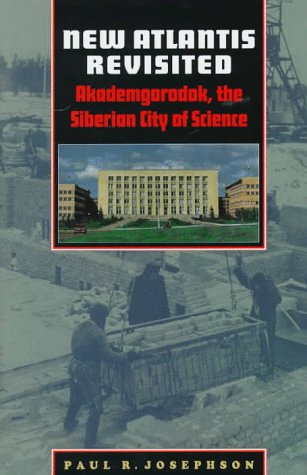
a book
New Atlantis Revisited
Paul R. Josephson · 1997 · 351 pages
In 1958 construction began on Akademgorodok, a scientific utopian community modeled after Francis Bacon's vision of a "New Atlantis." The city, carved out of a Siberian forest 2,500 miles east of Moscow, was formed by Soviet scientists with Khrushchev's full support. They believed that their rational science, liberated from ideological and economic constraints, would help their country surpass the West in all fields. In a lively history of this city, a symbol of de-Stalinization, Paul Josephson offers the most complete analysis available of the reasons behind the successes and failures of Soviet science--from advances in nuclear physics to politically induced setbacks in research on recombinant DNA.
Josephson presents case studies of high energy physics, genetics, computer science, environmentalism, and social sciences. He reveals that persistent ideological interference by the Communist Party, financial uncertainties, and pressures to do big science endemic in the USSR contributed to the failure of Akademgorodok to live up to its promise. Still, a kind of openness reigned that presaged the glasnost of Gorbachev's administration decades later. The openness was rooted in the geographical and psychological distance from Moscow and in the informal culture of exchange intended to foster the creative impulse. Akademgorodok is still an important research center, having exposed physics, biology, sociology, economics, and computer science to new investigations, distinct in pace and scope from those performed elsewhere in the Soviet scientific establishment.


recommended by 1 person
sourced from public statements
Tyler Cowen
“Imagine the Soviets trying to build a “city of science,” and meeting problem after problem. Yet “Marchuk acknowledged that in a number of fields researchers had contributed to…the speeding up of scientific technological progress. The physicists built synchroton radiation sources with broad applications; the biologists tacked plant and animal husbandry with vigor; the mathematicians, computer specialists, and economists were engaged in modeling and management systems.”↗