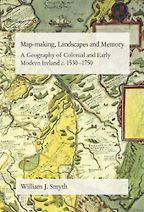
a book
Map-Making, Landscapes and Memory: A Geography of Colonial and Early Modern Ireland c.1530–1750
William J. Smyth · 2006 · 584 pages
Using the twin concepts of 'colonialism' and 'early modernity, ' William J. Smyth offers a geographical analysis of the most formative and revolutionary period in Ireland's history. He analyzes the conquest and settlement of Ireland by the New English and Scottish and the consequences of this often violent intrusion upon the cultures and landscapes of pre-existing Irish societies. Smyth focuses on the ways in which the early modern British state subjugated Irish territories, including British systematic use of surveillance techniques; implementation of mapping and inventories of strategic landscapes and resources; and development of bureaucracies and administrative techniques of law and the market economy so as to obliterate regional expression of Gaelic cultures and practices. What results is a fresh interpretation of Ireland's experiences in this crucial early modern period. "The richness of detail and command of sources is of course expected, as well as the good clear writing. It is his overall conception of this complex transformation, the insistence and intensity of his tracing of an Irish Ireland through it all, and his brilliant opening focus on maps and his 'deconstruction' of them that is all so very impressive. Clearly the author has wrought a masterpiece, a great landmark study, a geography of the utmost quality." --Donald W. Meinig, Maxwell Research Professor of Geography, Syracuse University "The story of Ireland c. 1530-1750 will always be retold. But few retellings will bring such a freshness of eye or depth of analysis as Map-making, Landscapes and Memory. Brilliantly conceived and meticulously researched, it captures the complexity and subtlety of Ireland's changing landscapes, identities, mentalities, and spaces with great skill and considerable style. Few authors can have done more to release the meaning embedded in maps, whether those produced by sixteenth and seventeenth century surveyors like Robert Lythe, Richard Bartlett, and Sir William Petty, or those produced in abundance by himself." --Robert A. Dodgshon, University of Wales, Aberystwyth


recommended by 1 person
sourced from public statements
